
No time to read? Liten instead on SPOTIFY!
Vol 1 | Issue 28 | ISSN 2979-8744 (online)
This week I'm asking a very simple question that I already know the answer to myself.
I am very addicted to opportunities. And I think it's no coincidence that many of us are.
We've talked before about how there's an industry built specifically to keep us treading water and spending our money on courses, competitions and festivals.
What I wanted to examine was why we keep investing so much of our unpaid time and energy into particular opportunities, and whether (and when) we know that we don't need to do that anymore.
The Power of What If
What if?
What if we win the lottery? What if we land that job? What if we buy that house? What if we lose five stone and become the version of ourselves that we aspired to be when we were 15?
What if we dare to try?
For us to follow our dreams, we have to believe in the power of what if.
This particular industry harvests the idea of the dream. Something I feel it missells is exactly how long it takes, how complicated it is, and how uneven the playing field is.
That all sounds rather cynical, but educational institutions will always want you to keep studying with them. Courses will always want you to buy another one. Competitions will always want you to enter again.
And that doesn't mean that the people who run these events, courses or competitions have malevolent intentions. They're most likely also trying to sustain a career within the industry, and providing training opportunities, script reading and competitions is an industry-adjacent way of doing that.
No hate to the people running these things (not least because I too am one of them!) Everyone's got to eat.
But I do look upon some opportunities with caution.
Sometimes they can prove to be a distraction from actually doing the work, and I've fallen into that trap myself.
Perhaps we've just finished a master's and we're considering a PhD. Or we've done script reading course and now we want to do script editing one. Maybe we want to make our own short film, so we become a director.
Perhaps we've worked on one script for several months and submitted it to one competition, so we pay to enter it into several more.
Some of these have their value and their purpose.
But not all.
It's always worth thinking about:
What will I gain from this?
What will this take away from me?
What will I have to sacrifice in order to do this?
Does it add to the trajectory and the plan that I have?
Finding the Right Opportunity
We've talked before about finding the right opportunity for the stage you're at, for the projects you've got, and for where you want to get to.
But depending on your level, this can still provide you with a continual stream of submission opportunities.
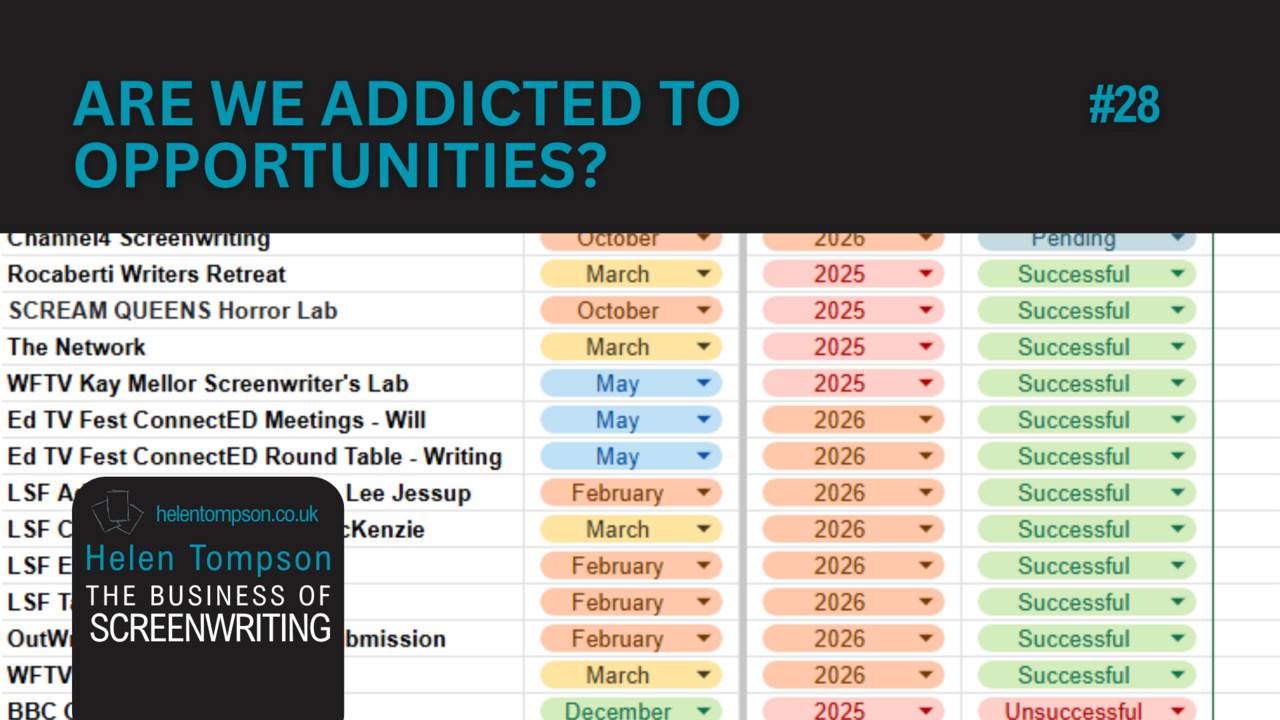
By the end of this year, I'll have submitted at least 36 applications for schemes, funds, competitions and industry opportunities.
Thirty-six.
But did I need to? Or were they providing a useful distraction from progressing further into my career?
Of the applications that have received a decision, I've had a success rate of around 24%, which I think is pretty good.
That's almost double last year's rate of around 13%.
At this trajectory, next year I could have a 50% success rate with my applications and submissions!!!
If only.
But do those numbers tell me that I'm becoming a better writer, more aligned with industry opportunities, and a more established writer?
Quantity Versus Quality
You have to look at the quality of those opportunities.
Most of my successful submissions this year have been table reads, script reads, career labs or mentoring, and one short script development opportunity.
When you compare that to last year, when I secured three industry-recognised labs, two of which were retreats, and a scholarship, the industry engagement was arguably much higher value.
When I look at the trajectory from last year to this year, even though my application success rate has increased, the value isn't necessarily comparable.
That said, value is only worth something to the person who holds it.
Where I've had table reads, industry conversations and mentoring this year, they've actually served a different purpose for me at this level.
Perhaps that's why I was more successful with those this year than in previous years, because I was at a point in my career where those industry conversations could have more value.
Some of the things I'm applying for this autumn and winter will potentially feed into opportunities I could participate in next year, such as BFI funding and other labs and schemes.
And a degree of layering your opportunities is, for me, what a lot of these submissions are about.
That said, they take up a considerable amount of time.
Some of these applications can take anywhere from five hours to the equivalent of five days, depending on the rest of my workload.
Five days!
Imagine what I could write in five days.
And actually, even that's not quite as straightforward as it sounds.
One of my successful applications this year was for a three-hour career lab at the London Screenwriting Festival, where I met Hayley McKenzie. We connected really well, maintained that relationship, and she's now coming along to my showcase.
On paper, that's a three-hour lab. But the value of that opportunity has continued well beyond those three hours.
Compare that to spending a week at a writers' retreat, which might look like a much more substantial opportunity. And it absolutely has value in terms of developing your craft and spending time with other writers. But if those relationships don't continue beyond the retreat, the longer-term professional benefits might actually be less significant.
So perhaps we need to stop measuring opportunities purely by what they offer at the point of application and start looking at what they lead to afterwards.
The Cost of Applying
One of the benefits of logging all my activities into a spreadsheet is that I can provide these statistics.
I can look pragmatically at where the holes in my ship are, what's draining my time and resources, and what's worth it.
I think it's always worth considering what you're hoping to get out of an opportunity and what you've got to sacrifice to be able to apply for it.
Because quite often that's a lengthy form.
Sometimes you need to prepare a budget, talk to other stakeholders, understand their experiences or establish what their input into a project might be.
Before applying, it's worth taking the time to:
Understand the organisation and what the offer actually is.
Look at your existing commitments and whether you can meet the deliverables.
Check whether you qualify.
Consider whether the organisation aligns with your particular values and interests.
Think about what the opportunity could realistically do for your career.
There are so many more things to consider than just, "Ooh, there's an opportunity. Let's apply."
When Is Enough Enough?
I'm still not convinced that submitting scripts to competitions for laurels and validation is terribly conducive to making an impact beyond what a potential script reader, developer, script editor or filmmaker has said personally about your work.
There are very few schemes and competitions that actually make the industry sit up and take notice.
And perhaps that's the question we should be asking ourselves more often. Are we applying because this particular opportunity could genuinely help us take the next step?
Or are we applying because the possibility of being selected feels like progress?
I'm certainly not immune to that. After all, I've just admitted to making 33 submissions in a year. And I'll probably make more.
But I am becoming increasingly conscious that every hour I spend filling in an application is an hour I'm not spending writing.
And at some point, I have to ask myself which of those things is going to get me closer to where I want to be.
Your Task This Week
Your task for this week is very specific.
Write down all the things you've applied for this year and whether they were successful.
If you know roughly how long they took, make a note of that too. Consider tracking future opportunities in a spreadsheet.
Think about whether those applications were frivolous ("I'm going to submit here because I can") or whether they genuinely served a purpose.
Look at what you've gained from the successful ones, and whether that was what you actually needed.
You might be surprised by what you discover. I certainly was.
And perhaps next time an exciting opportunity lands in your inbox, you'll stop for a moment before reaching for the application form.
Or, like me, you'll add a new row and add it to your spreadsheet.
Old habits die hard.
Helen
Next up… Managing Expectations - Researching Writers
© Helen Tompson 2026 | Feel free to share this newsletter with other writers. If you'd like to reproduce or quote larger sections, just drop me a message first.